When states articulate their “grand strategy,” we tend to imagine something rigid and material: troop movements, defence planning, alliances, budgets, or diplomatic frameworks. Strategy evokes the image of generals in a room surrounded by maps. Yet before a strategy is implemented, it is expressed in language. Official strategy documents, from national security strategies to defence white papers, are carefully crafted political texts. They are written to be read by allies, rivals, markets, and domestic audiences. If we treat these documents as data, a simple question can be raised: What do great powers talk about when they talk about strategy?
To answer this question, I have compared the language of four actors whose strategic worldviews shape global politics today: the United States, China, the European Union, and Russia. Using R and a small topic dictionary, I counted how often each document referenced six major themes common in strategic discourse: security, diplomacy, economy, environment, ideology, and technology. The result is a visual snapshot of how each power narrates its place in the world, and the differences are striking.
Grand Strategy as Language
Grand strategy is usually defined as the alignment of a state’s ends, ways, and means: a long-term plan linking national objectives to the instruments of power. But scholars such as Balzacq, Dombrowski, and Reich have argued that grand strategy is also a discourse. It is the story a state tells about the threats it faces, the opportunities it sees, and the identity it claims. The words chosen in these documents reflect more than policy: they signal priorities, fears, and ambitions.
Language becomes strategic in itself. It shapes expectations, justifies action, and signals intentions outward. A country that repeatedly invokes “sovereignty” and “security” paints a different picture of the global order than one that foregrounds “partnership”, “climate”, or “innovation”. Understanding these differences helps us better grasp how major powers see and prepare for the world around them.
A Simple Analytical Approach
To map this strategic language, I have collected four official documents published in English:
- United States – National Security Strategy (2022)
- China – Defence White Paper (2019)
- European Union – EU Global Strategy (2016)
- Russia – National Security Strategy (2021)
The texts were cleaned, tokenised, and analysed in R. I have built a dictionary of keywords associated with six strategic categories: diplomacy, economy, environment, ideology, security, and technology. For each country, I calculated the share of words belonging to each category relative to all topic-matching words.
Of course, counting words is not the same as measuring policy. Nonetheless, this method showcases certain areas of emphasis, which possess interpretive significance. Governments highlight what they want readers to notice. They repeat what they consider most important. And they silence what they prefer to downplay. The frequency of key themes is therefore a simple but powerful indicator of strategic worldview.
Findings: Four Strategic Voices
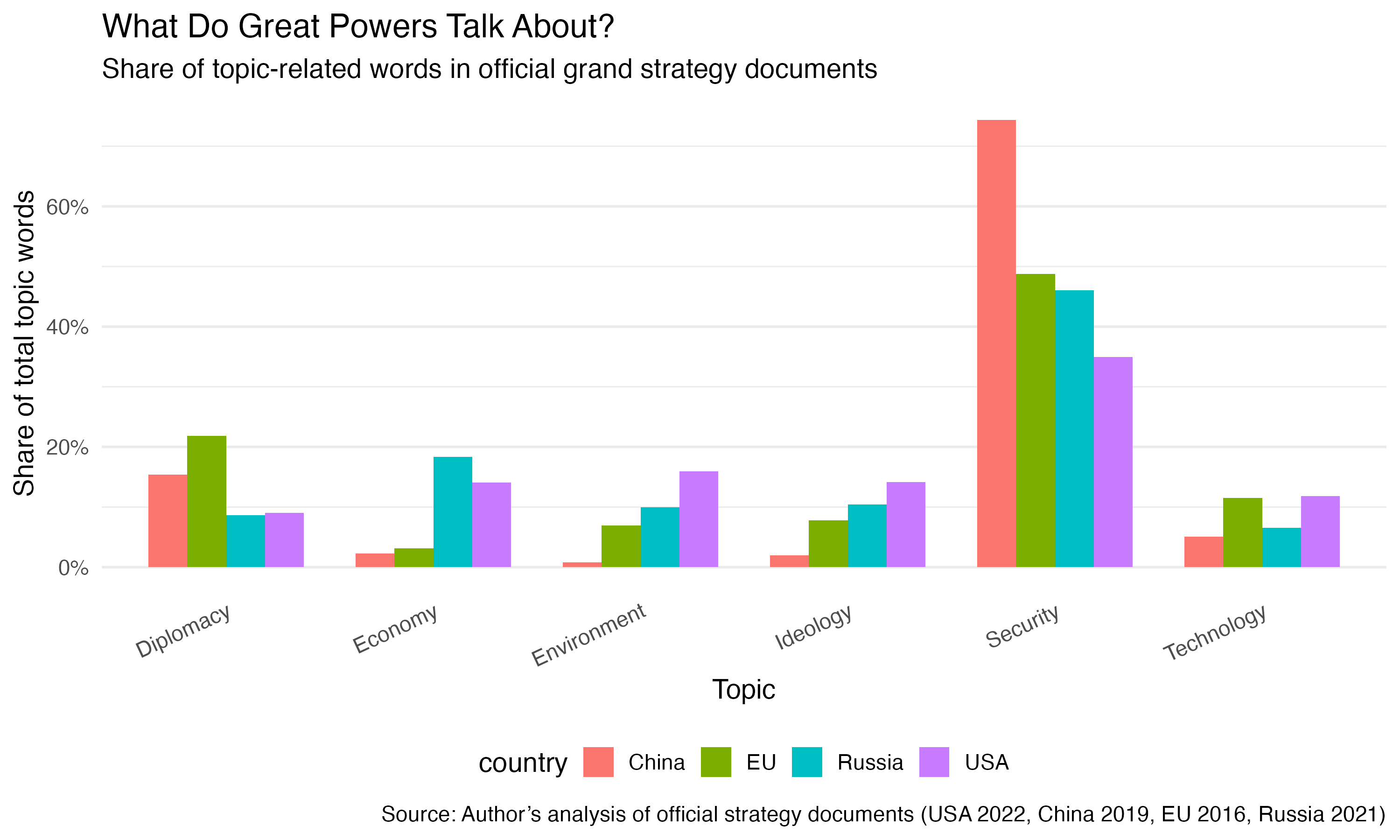
The resulting chart reveals four very different strategic narratives among major global actors.
- China: Security Above All
No other document resembles China’s. Nearly 70% of its topic-related words fall into the security category, far more than any other country. This overwhelming emphasis reflects the nature of the document itself, but it also fits China’s broader strategic narrative: stability, sovereignty, and territorial integrity dominate the text.
China’s language is defensive and focused on perceived vulnerabilities. Threats, deterrence, military modernisation, and national unity are constant themes. The theme of diplomacy appears in the document as well, yet only in a subordinate role. Economic and ideological concepts are barely present in comparison with the others.
This linguistic profile portrays a state that interprets the world primarily through the lens of security competition and internal stability, framing strategic challenges as threats to be mitigated rather than opportunities to be pursued.
- European Union: A Strategy of Cooperation
In contrast, the European Union presents almost the mirror opposite. The EU’s strategic language is significantly more balanced, with diplomacy leading the other themes at over 20%, the highest diplomatic emphasis among the four actors. The EU also devotes substantial space to the environment, ideology (values), and technology, with none of the topics overwhelmingly dominating the others.
This distribution reflects the EU’s self-conception as a normative, multilateral actor. Words like partnership, cooperation, climate, and multilateralism are central to its strategic identity. Even security-related language, while present, appears alongside and often subordinate to broader themes of collaboration and global problem-solving.
The EU’s discourse portrays the world as a complex set of interconnected challenges that demand cooperative solutions rather than zero-sum competition.
- Russia: Security, Sovereignty, and Economic Resilience
Russia’s strategic profile combines a strong security emphasis (around 46%) with a surprisingly large economic component (around 18%). This aligns with Russia’s narrative of a state under pressure, seeking both military strength and economic sovereignty.
The prominence of economic language likely reflects ongoing concerns about sanctions, energy markets, and internal resilience. Russia’s language emphasises sovereignty, tradition, and national identity, though the ideological category remains smaller than expected. Diplomacy appears but mostly in contexts of asserting great-power status rather than cooperative engagement.
Overall, the Russian text frames strategy as a struggle for autonomy and stability in a hostile environment.
- United States: Values, Technology, and a Broad Strategic Agenda
The United States shows the most diversified strategic language. While security remains important (35%), the U.S. stands out for its strong emphasis on ideology (democracy, freedom, rights) and technology. These two categories appear far more prominently than in the other documents.
This reflects the 2022 National Security Strategy’s focus on geopolitical competition framed through values and technological leadership. Democracy is presented as a strategic asset, and technology, especially AI, cybersecurity, and innovation is treated as a central battlefield of great-power competition.
The U.S. also devotes significant attention to climate and environment, further reinforcing the broad thematic range of its strategy. In short, the U.S. articulates a worldview in which competition is fought as much in the realm of ideas and innovation as in military terms.
A World of Diverging Strategic Narratives
Taken together, the linguistic profiles of these four actors reveal remarkably different strategic imaginations:
- China frames the world primarily as a series of security threats.
- Russia sees a hostile environment requiring military power and economic resilience.
- The EU treats global challenges as cooperative problems requiring diplomacy and climate action.
- The U.S. blends security with ideology and technological competition.
These differences are not merely stylistic. They reflect deep-rooted ways of perceiving the international system. When states articulate their strategies, they reveal their priorities, their anxieties, and the futures they believe are possible.
Text analysis cannot replace traditional strategic studies, but it offers a powerful complement: a way to detect the patterns hidden in plain sight. Words matter, especially when they are the words states choose to define their place in the world.
The result is a simple but revealing conclusion: grand strategy begins with language. And in those words, we can see four very different visions of global order taking shape.
Written by Ferdinand Roniger, Edited by Leo Hirnschrodt