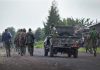

For three decades, the eastern Democratic Republic of Congo has been trapped in a conflict whose origins lie not in its own borders, but in the aftermath of the 1994 Rwandan Genocide. Today, despite an estimated 7.8 million internally displaced people, recurring massacres, and yet another peace agreement signed in mid-2025, the crisis remains largely invisible in international politics and media. This invisibility is not accidental. It serves a system in which regional governments, global corporations, geopolitical actors, and elements of the Congolese state all benefit from the continued instability of the region.
The Wound That Never Closed
The roots of the current crisis lie in Rwanda’s post-genocide collapse and Congo’s inability to contain its spillover. When militias responsible for mass killings fled across the border in 1994, they entered what scholar Jason Stearns calls a “security black hole”: a failed state under Mobutu with no functioning administration, no army discipline, and virtually no presence in the east. The refugee camps established on Congolese soil became, in Stearns’ words, “inverted Rwanda”, spaces where former génocidaires reorganised, reproduced their power structures, and prepared new incursions, indirectly enabled by international humanitarian aid.
Rwanda’s new government, feeling existentially threatened, intervened militarily. What followed was a regional war involving armies from nine African states and dozens of proxy groups, battles as much about controlling mineral-rich territories as about security. Even after the official end of the Second Congo War in 2003, violence never ceased. The region had failed to build a political settlement after 1994, so it built a decades-long war instead.
A System Thriving on Violence
At the core of this system lies what might be called structural violence; violence so embedded in political and economic systems that it becomes normal, predictable, even profitable. Violence in Congo is not irrational chaos but bureaucratic and economic: militias act as tax collectors, commanders regulate labour in mines like corporate managers, and soldiers trade weapons with the very rebels they claim to fight.
Rwanda’s and Uganda’s profit from Congolese resources was not incidental but a governing strategy. Both countries established taxation systems, mining partnerships, and trading routes that enriched political elites while maintaining plausible deniability through proxy militias. The UN Group of Experts reports in 2022 and 2024 continued to document support for armed groups controlling mineral sites. But Congolese elites are equally complicit: Forces Armées de la République Démocratique du Congo (FARDC) commanders run checkpoints and smuggling networks, Kinshasa officials sign mining deals they cannot control, and former rebel leaders integrated into the state continue their wartime business.
That ordinariness is part of the problem. When violence becomes a routine part of governance, it stops being a failure and becomes a method. It produces revenue, authority, and obedience. And once violence becomes useful, it rarely disappears. The global demand for cobalt, coltan, tin, and tungsten—essential for smartphones, electric vehicles, and renewable energy—depends heavily on Congolese extraction. When mines operate in militia-controlled zones, extraction is cheaper, regulation weaker, and accountability nearly non-existent. Multinational companies, whether knowingly or through opaque supply chains, benefit from this system.
As journalist Manuela Pokossy observed: “When two brothers tear each other apart, the third party benefits.” In Congo’s case, the “third party” is not a single actor but an entire network of geopolitical and economic incentives. The violence is borne almost entirely by civilians. Sexual violence, used systematically as a weapon of war, serves as a strategic tool for terror, displacement, and control, thriving in conditions of near-total impunity.
An Unattainable Peace
Peace is a balance of interests, more than a text. And in Congo, that balance rarely leans towards ending the war. The June 2025 peace deal, like many before it, promised disarmament and regional cooperation but offered no credible enforcement mechanism and no plan to restructure the political economy that fuels the conflict. Within weeks, violence resumed. This failure was predictable.
Peacebuilding efforts since 2003 have consistently failed because they focused on national and regional levels while ignoring local conflicts rooted in land disputes, ethnic tensions, and the persistent presence of Rwandan Hutu militias. The international community addressed symptoms, not causes.
For peace to be reachable, it would have to be more advantageous than conflict. It would require militias to surrender territories that fund them, state actors to abandon networks sustaining their power, neighbouring governments to forgo influence, and global markets to accept real transparency in minerals that keep industries running. It would require the UN to reckon with its own contradictions: a peacekeeping mission perceived as both indispensable and intrusive, present yet rarely transformative. Reuters reported in 2023 that UN peacekeepers faced suspension over sexual abuse allegations, illustrating how even those meant to protect civilians can become part of the system of impunity.
None of this is impossible. But it demands a collective willingness that has never materialised. Peace becomes unreachable not because the conflict is eternal, but because those who might enforce change face fewer costs by tolerating the status quo. The violence is far away, and those who suffer it are rarely the ones whose voices shape foreign policy or consumer demand.
The Mirror We Refuse to See
Why does Congo remain so absent from international consciousness? Partly because the conflict resists simple narratives. It has no single villain, no clear timeline, no identifiable end. Partly because Western publics struggle to confront their complicity in extraction systems linking Congo’s suffering to global consumption. And partly because fragmentation creates plausible deniability: dozens of groups, unclear alliances, fluid identities mean no one actor can be blamed, and everyone can claim they’re protecting civilians.
However, ignoring Congo is a luxury built on someone else’s suffering. The world relies on Congolese minerals to power its green transitions, digital infrastructures, and technological innovations. Properly acknowledging the conflict requires transparency, accountability, and the political will to change.
To expose who profits from Congo’s invisibility is to confront the uncomfortable truth that violence persists not because it is inevitable, but because it is useful.
Structural violence thrives in silence. Breaking that silence requires not only documenting atrocities but analysing the systems behind them. For too long Congo’s war has been treated as an anomaly: a tragic exception in an otherwise functioning global order. It is time to see it instead as a mirror reflecting the deep inequalities and opportunisms of that very order.
Written by Divine Boyembe, Edited by Valerie Schicke
Photo Credit: Wikimedia Commons (uploaded on March 1, 2013)